

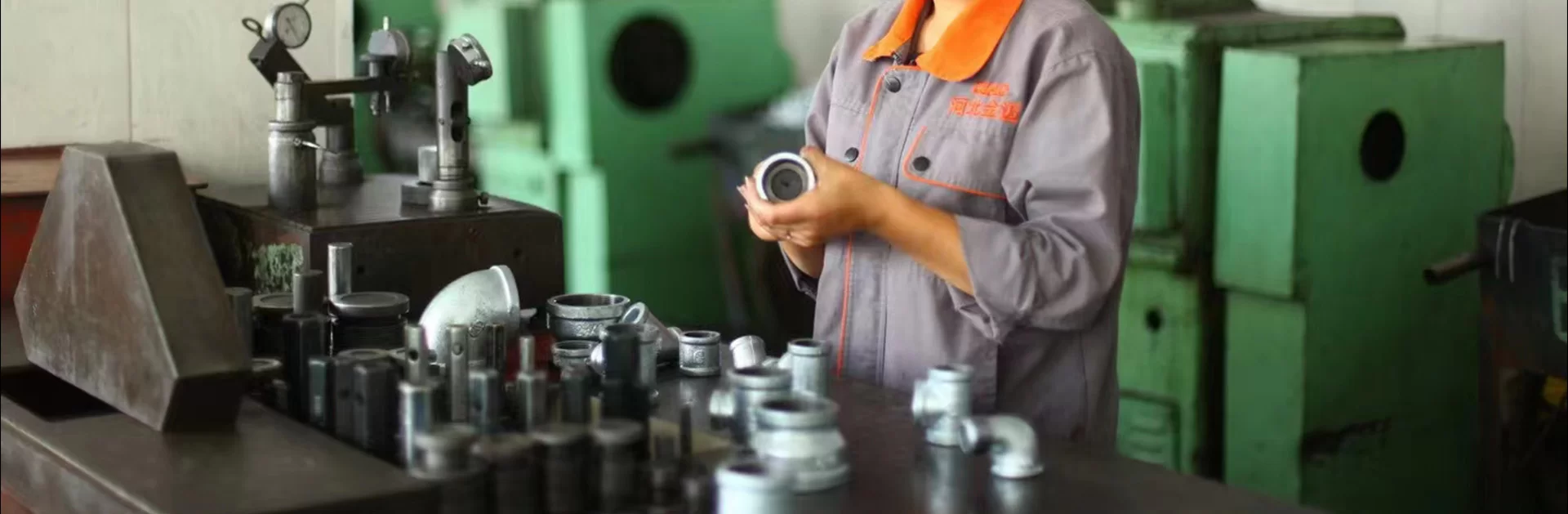

Malleable cast iron remains a cornerstone of industrial piping due to its unique balance of ductility and strength. Unlike standard grey iron, which is prone to brittle fracture under stress, malleable iron undergoes a specific annealing process that allows it to withstand significant impact and pressure. This makes it indispensable for HVAC, fire protection, and water supply systems where structural integrity is non-negotiable.
For procurement officers and engineers, selecting malleable iron fittings suppliers requires a deep understanding of metallurgical consistency and coating quality. The primary challenge in industrial piping is not just the initial fit, but the long-term resistance to oxidation and the minimization of pressure loss across complex network transitions. Ensuring a leak-proof connection in demanding environments depends heavily on the precision of the threading and the thickness of the protective zinc layer.
This technical guide provides an in-depth analysis of the selection criteria for high-performance fittings. We will examine the mechanical advantages of precision casting, the role of hot-dip galvanization in extending service life, and the specific operational parameters that distinguish premium industrial components from standard alternatives, providing a roadmap for optimizing piping network reliability.
Evaluating Malleable Iron Piping Infrastructure
The transition from basic cast iron to malleable iron represents a significant leap in engineering safety. The core difference lies in the graphite structure; through a prolonged heat treatment process, the carbon in the iron is rearranged into "temper carbon" nodules. This transformation eliminates the internal stress points found in grey iron, granting the material the ability to deform slightly under load rather than snapping. In the context of B2B industrial procurement, this mechanical resilience is critical for systems subject to thermal expansion, vibration, or accidental mechanical impact. HEBEI JINMAI CASTING Co., Ltd. leverages this material science, utilizing a factory area of 40,000 square meters to maintain the strict temperature controls required for this annealing process. By integrating high-strength malleable iron with precision casting, the resulting components offer a compact structural design that does not compromise on wall thickness, ensuring that the fitting can handle high-pressure surges without the risk of catastrophic failure.
Strategic Procurement and Technical Analysis
Optimizing a piping network requires moving beyond simple dimensional matching to a comprehensive evaluation of fluid dynamics, corrosion kinetics, and installation costs. The following sections detail the critical technical dimensions that determine the performance of malleable iron components in professional settings.
Material Properties and Thermal Treatment
The structural stability of a fitting is determined by the metallurgical grade of the iron and the precision of the annealing cycle. High-strength malleable iron is engineered to provide impact resistance that far exceeds standard cast iron. This is particularly important in environments where piping is exposed to external stresses or high-frequency vibrations. The goal is to achieve a homogeneous grain structure that ensures uniform strength across the entire geometry of the fitting, preventing weak points at the junctions.
| Comparison Feature | Standard Cast Iron | Malleable Iron | Operational Impact |
|---|---|---|---|
| Durability | Brittle / Low Impact | High / Impact Resistant | Lower failure rate under stress |
| Material State | Grey Graphite Flakes | Temper Carbon Nodules | Increased ductility and toughness |
| Pressure Handling | Moderate | High Stability | Suitable for high-pressure surges |
| Thermal Response | Prone to cracking | Flexible Expansion | Better for HVAC cycles |
| Structural Integrity | Variable | Consistent | Predictable lifecycle performance |
| Failure Mode | Sudden Fracture | Plastic Deformation | Higher safety margin in leaks |
Precision Threading and Fluid Dynamics
Fluid turbulence at pipe junctions is a primary cause of pressure loss and internal erosion. Precision-engineered transition zones between internal and external threads are essential to maintain a smooth bore. By utilizing advanced machining, these fittings minimize the "step" effect where the pipe meets the fitting, thereby reducing turbulence. This is critical in high-flow industrial water supplies where efficiency directly impacts pumping costs and energy consumption.
Anti-Corrosion Galvanization Standards
Rust and oxidation are the leading causes of fitting failure in humid or chemical environments. Hot-dip galvanization provides a superior barrier compared to electro-galvanizing because it creates a thicker, metallurgically bonded zinc layer. This coating not only protects the surface but provides sacrificial protection, where the zinc corrodes in preference to the underlying iron, significantly extending the operational life of the piping network in outdoor or industrial settings.
Industrial Application Scenarios
These components are specifically designed for environments where space is limited but reliability is paramount. In HVAC interfaces, the compact diameter transition allows for intricate layouts without compromising flow. In fire protection networks, the high pressure resistance ensures that the system remains intact during emergency activation. The versatility of the material allows it to be used across varied climates, provided the surface treatment matches the environmental corrosivity.
Installation Efficiency and Tooling
From a labor perspective, the precision of the threads is the most important factor. Standardized threading (ISO/National Standards) allows for rapid screw-in installation using standard tools, reducing the need for specialized heavy equipment. When threads are machined to tight tolerances, the amount of sealing material required is minimized, and the risk of cross-threading is significantly reduced, which accelerates the overall project timeline.
Quality Verification Protocols
A professional quality assurance process must include both dimensional accuracy testing and hydrostatic pressure testing. Every batch should be audited to ensure that wall thicknesses are consistent and that there are no casting voids. Automated pressure testing alerts help identify defects that are invisible to the eye, ensuring that zero-defect shipments are delivered to global clients, a standard maintained by HEBEI JINMAI CASTING Co., Ltd. across its international shipments to 56 countries.
Lifecycle Value Assessment
While the initial cost of malleable iron may be higher than basic cast iron, the total cost of ownership (TCO) is lower. This is due to the reduced frequency of replacements and lower maintenance requirements. The combination of impact resistance and hot-dip galvanization ensures a long service life, meaning the cost per year of operation is significantly reduced, especially in critical infrastructure where the cost of a single leak can be catastrophic.
FAQ
What is the technical difference between malleable iron and standard cast iron?
The primary difference is the annealing process. Standard grey cast iron is brittle and can crack under impact. Malleable iron is heat-treated to transform the graphite structure into nodules, which grants the material ductility. This means it can absorb energy and deform slightly without fracturing, making it far safer for high-pressure industrial piping.
How does hot-dip galvanization improve the life of pipe fittings?
Hot-dip galvanization involves immersing the iron in molten zinc, creating a thick, bonded coating. This layer acts as a physical barrier against moisture and oxygen. More importantly, it provides cathodic protection; if the surface is scratched, the zinc will oxidize instead of the iron, preventing rust from spreading beneath the coating.
Are these fittings suitable for fire protection systems?
Yes, they are ideal for fire protection. Due to their high pressure resistance and structural stability, they are frequently used in pipeline renovations and diameter conversions. Their ability to withstand sudden pressure surges during system activation makes them a reliable choice for life-safety infrastructure.
How can I ensure a completely leak-proof connection during installation?
While precision threads provide a tight mechanical fit, a 100% leak-proof seal requires high-quality sealing materials. We recommend using PTFE tape or a professional-grade pipe sealant. Proper application involves wrapping the tape in the direction of the threads to ensure the sealant is compressed into the gaps as the fitting is tightened.
Which applications benefit most from the compact design of malleable fittings?
Compact fittings are most valuable in HVAC interfaces, building water supply/drainage systems, and industrial pipe reductions where installation space is limited. The optimized diameter transition allows engineers to route piping through tight corridors without creating excessive turbulence or requiring bulky transition components.
What standards should I check when evaluating a supplier's fittings?
Buyers should verify compliance with international thread standards (such as ISO or National Standards) to ensure interchangeability. Additionally, check for pressure test certifications and the thickness of the galvanization layer. A reliable supplier should provide dimensional accuracy reports and proof of hydrostatic testing for critical batches.
References and further reading
- International Organization for Standardization (ISO) - Pipe Threading and Casting Specifications.
- Industrial Metallurgy Handbook - Analysis of Annealing Processes for Malleable Iron.
- ASTM International - Standards for Hot-Dip Galvanized Steel and Iron Coatings.


